My Parents Called 1970 “Ugh, That Year”

The last date I had was a set up. According to our mutual friend, who arranged it, we were a perfect match.

The first thing I notice about my date is how seriously he takes his martini. His order comes with three instructions, and he warns the waiter he’ll be able to tell if any one of them hasn’t been followed. Why would anyone take liquor so seriously? (thought the woman who drinks wine out of a box). Or — to put it another way — this may be yet another man who won’t get me one bit.

He says, “I’ve just moved back to Baltimore after many years in Manhattan.”

I say, quietly, “I lived in Manhattan once, in the early 70s.”

“Oh?” I can tell I’ve interrupted his flow because his response is a bit snappy. Did I mention his ancestors may have traveled over on the Mayflower? Our first six minutes together have led me to this theory. “Where?” he asks but I can tell he’s just being polite.

“Upper West Side. “The Apthorp.”

“Really?” he perks up. He starts throwing out names — one of them famous — of people he knew at The Apthorp. He tells me he went to a few parties there. He orders another drink.

* * *

When Paul Goldberg said, “Wait!” on that sidewalk in Cortland NY, I turned back. And then I walked right into his life. By the evening he was making me tea and we were spilling our secrets.

His plan had been to go to Berkeley, where he felt he could do the most good. After two days of being together, we realized we couldn’t be apart. But there was a pragmatism to our love, too. We sensed my oh-so-new conversion to left-wing politics wasn’t ready for a cross-country move quite yet.

Over toast with grape jelly on our fifth morning together, we decided to relocate to Manhattan — where he’d grown up and his mother still lived. We’d stay with her until we found our own place.

My parents always referred to 1970 as “Ugh, that year.” I didn’t see their point until about 1980. One minute I was the usual college coed, asking for money and fibbing about grades, boys, and how I spent my time. Suddenly I was lecturing them about Huey Newton and male chauvinism. I called them to announce — with gravitas leaking from every pore of my body — my intention to leave school and move in with Paul.

Here’s where they landed: “Just understand you won’t be welcome home for Thanksgiving. Or Christmas.” After that my parents and I went to our respective corners and had a series of miserable conversations that went nowhere.

And soon after that, Paul and I emerged from the subway station at 79th and Broadway, and I took a look at my new home.

The Apthorp is an Italian Renaissance Revival beauty, taking up a whole city block. It comes with iron gates and limestone sculpture and a courtyard rimmed with trees and lamp posts. The men who stood guard at the entrance called Paul by name. The grandness of the place got more in focus the closer we got to his mother’s apartment. The elevator operator in a uniform. Fresh flowers. If I’d been paying more attention in Psychology class, I wouldn’t have been at all surprised that this grandeur spawned Paul Goldberg, Leader of the Revolution.

I kept rubbing my sweaty hands on my skirt as he opened the door for us, sure Paul’s mother was the kind of woman who shook hands when she met you. I was pretty sure she wasn’t a hugger. But maybe she was.

We waited. It seemed a while before she walked into the living room.

“And is this Linda?” She said my name as though she wasn’t sure she had it right. Pretty quickly I knew there would be no need for dry hands. I was not what she was expecting.

“I see you’ll be staying with us,” she said as she looked down at my luggage. “Perhaps my son might have let me in on the secret.”

And that was my welcome to the storied Apthorp building. This signaled the start of my attempt to climb into the bosom of Paul’s family since I was pretty sure mine would never talk to me again.

As I slept that night, ambulances careened up and down Broadway and woke me. I jumped every time. Paul told me I’d get used to it.
It was 1970. I Was Late to the Revolution

My sophomore year in college continued in the tradition of my freshman year. Socially, I was golden. Academically, I counted on short bursts of manic studying with equal parts dumb luck and using my charm whenever I could. By spring, I was squeaking by. Barely.

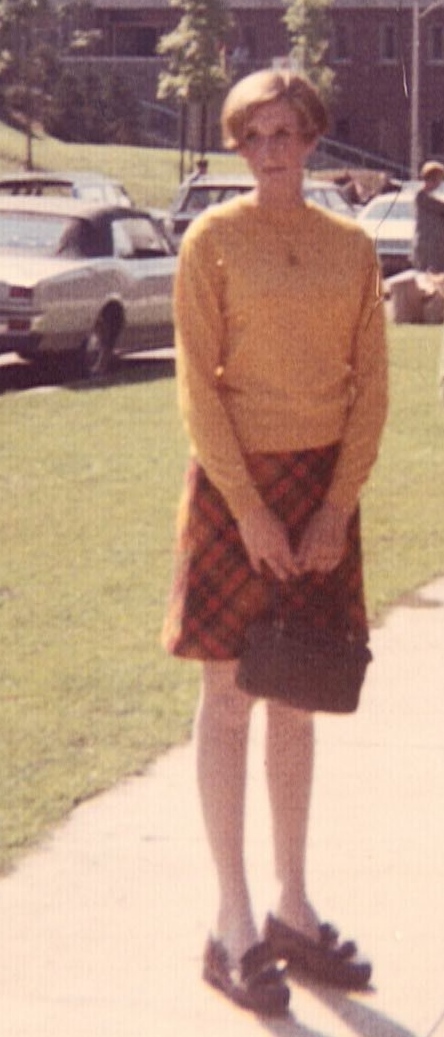
I looked like the same girl who had arrived on campus two years before. My wardrobe of choice was one of the miniskirts my mother had made me, a matching headband, and a blouse I was sure rendered me “cute.” I slept every night with my hair in rollers so big it was amazing I didn’t throw my spine out of alignment.

April 30, 1970, at the tail end of sophomore year, I decided to get serious about grades. This Hail Mary maneuver happened every semester, but I sensed I was in more trouble than usual. I was studying. But then I got hungry and walked to the Student Union for a slice of pizza.

There was a crowd fixated on the television there. I couldn’t see the screen.

“What is it?” I asked the person next to me.

“Nixon just invaded Cambodia.”

Lots of short sentences have changed the course of my life. “Let’s get married,” was one. “You’re pregnant,” was one. “Try it,” was one.

“Nixon just invaded Cambodia” is up there with all of them.

Here’s where I go off on a little tangent about my generation’s place in history. This is what makes Baby Boomers annoying to anyone who came before or after us. But the truth is, when we were teenagers, so much came shooting at us all at once. Things gave way.

The war had been going on since we were in junior high school. Most of us knew someone — or knew someone who knew someone — whose life had been thrown into utter chaos because of it. Some had a closer view of the loss. Some were the lost.

All of this happened: Four girls killed in a Birmingham Church. Protestors crossing the Pettus Bridge. Goodman, Schwerner, Chaney. The March on Washington. Stokely Carmichael rose up and shouted “Black Power” for the first time.

My senior year in high school witnessed the death of Martin Luther King, Jr. and then Robert Kennedy nine weeks later. Trusting the universe, something 1950s kids were really good at, became harder to do.

And as women, the role we’d been taught to believe was coming our way was not coming our way, it turned out. We would not get married weeks after college graduation. We would not become housewives and have babies in our early 20s, the way our mothers had. And we’d have a lot more sex. Our mothers did not like that part at all. So we felt jubilant some of the time and guilty the rest.

As soon as Nixon announced the invasion of Cambodia that night,  several groups — all with differing agendas — started forming outside, loud and angry. They ranged from “America, Love it or Leave it” to a less structured group chanting “Drop Acid, Not Bombs!” And a few in between, with messages harder for me to glean. It was a political smorgasbord. I had a lot of catching up to do.

In the next few days, I listened to speeches and read as much as I could. I irritated friends by lifting slogans, sometimes complete paragraphs, from works I didn’t fully understand. I wrote my parents terrible letters about how horrified I was that we were middle class. My mother wrote back: “Would you rather be upper class or lower class?” and I screamed at her into the phone that she’d missed the entire point — in fact she missed every point of my entire life.

Cortland, like almost every campus in America, had upended. We were officially on strike. I had a fleeting moment of worry about my grades. As always, I’d been counting on a miraculous showing during exam week to carry me through. Finals wouldn’t happen now.

I had to put aside childish worries, like grades or what my parents thought. I had more serious commitments now, a revolution to join. I jumped. No parachute.

[Next Thursday: Love in the Revolution]

My 7-Word Brush with Helen Gurley Brown

The phone rang while I was making dinner. My kids were underfoot. It was 1986, we didn’t have Caller-ID yet, and I always suspected telemarketers at that time of day. I tried to answer with an attitude, making it clear we didn’t need new windows or a timeshare in Jamaica.

The voice on the other end was low and commanding, and her name was Myra. She was a senior editor at Cosmopolitan, following up on a query letter I had sent a month before. She was quick and to the point.

“We’d like to hire you to write the article you’ve proposed. We can offer $3,000 with a kill fee.”

I was not yet calling myself a writer back then for fear I would be outright lying. I was piling up meager checks here and there, mostly from parenting magazines and newspaper op-eds. When she said $3,000, I was conscious of not hyper-ventilating into the receiver.

I had queried Cosmo about an article idea I knew nothing about — not unusual for me back then (or now, come to think of it). The topic was the relatively new phenomenon of single career women deciding to have a baby on their own, without a husband or even a boyfriend in their lives. Tame by today’s standards, there was a time when this was groundbreaking.

Myra wound up our conversation with this: “The first draft will be due in six weeks. Of course Ms. Brown will have final say. I’ll be in touch after she reads it.”

I got off the phone, positively giddy. Then I realized Ms. Brown was Helen Gurley Brown. And my knees shook a little.

The next day, I began my research. Since email was not yet the communication of choice, I did everything by phone while my kids sat in front of the television, eyes glazed over by Gilligan Island reruns. It was not my best mothering moment, but — hey — I was going to have a byline in Cosmo.

I felt a connection to the women I interviewed even though I’d gone the conventional route toward motherhood. They were smart and savvy. Their stories were poignant, about their dreams to have a baby, about running out of time. Myra had made it clear in our first conversation that the magazine did not approve of this new way to form a family and my piece should reflect that slant.

I thought I knew better. On the day I put my draft in the mail, I believed I was going to make journalistic history. A few days later, the phone rang. It was Myra.

“We received your draft and Ms. Brown has seen it.  I’m going to read from her memo.”

Here is what Helen Gurley Brown thought of my draft: “This writing is smug, small, and sanctimonious.”
I’ve always loved the idea that she brought forth alliteration to cut me off at my writing knees.

Here’s the good news. There was a kill fee waiting for me that exceeded my wildest expectations. I thought HGB was wrong about my writing, but I still had some wounds to lick. So I licked them. And I developed a clever answer for  friends who kept asking when my article was going to appear in Cosmo.

And the bad news? There wasn’t any. My keyboard was still waiting for me in the morning, with all its possibilities. So I sat down. And I got back to work.

General Hospital, Baking Pies, and Why I Never Made Dean’s List

My list of college accomplishments was short. I was guilty of falling in and out of love hard and spending too much time in front of my mirror. I didn’t have a clue how to balance a check book or to begin writing a term paper any sooner than the night before it was due. All true.

But thanks to my cousin, Kathy, I learned to bake a pie while I was in college. I’m putting that down as my #1 achievement, sad as that may sound to those of you who made Dean’s List. I’ll own it.

As kids, Kathy and I grew up a few miles from each other on Long Island. We shared family meals and holidays. We spent shimmery afternoons playing hide-and-seek in the apple orchard across from her house. Now, by coincidence, we had both relocated to Cortland. I was a student (at least some of the time), and she was a young wife and mother.

I’ll blame this on her, but it surely could have been my fault: Somehow, we got hooked on General Hospital.  Since I didn’t own a TV, I would stop by her apartment a few afternoons a week to see what was happening in Port Charles. She would put her son down for his nap. After the scintillating dialogue and plot twists had consumed an hour, we’d tiptoe past her sleeping toddler’s room and go to the kitchen.

She would make a pie. I was her helper, doing the easy jobs, like whisking the flour and sugar together or coaxing ice water from cubes. Kathy would use her pastry blender to cut in the shortening. Then her fingers — quick and deliberate — to form tiny pebbles of dough before she would begin drizzling in the water.

Kathy came from a home where my aunt made everything from scratch, even brioche French toast. My mother was most comfortable reaching for an easy fix in the freezer and had a whole comedy routine about it. She called herself “The Swanson family’s best friend.”

Kathy was also the cute one — blonde and perky, and a cheerleader. I was the spindly one who took forever to grow into her stork legs. Then, in our late teens, it all changed. She married young and had a baby. I went off to college. As I was making fraternity parties and football games my full-time endeavor, Kathy was planning casseroles on a budget and researching preschools.

“I think I’m going to break up with Paul,” I might say as we baked on those lazy afternoons. She would already be crimping the dough into the pie pan as I was still going through the merits (or shortcomings) of Paul, or Tim, or Peter. She kept them all straight, a credit to her cousin love.

She talked about toilet training, and I tried to add comments where I could. We told stories about our mothers. We worried General Hospital was turning our brains to mush, but admitted we couldn’t give it up. We’d chat up until the last minute, until her son began calling, “Mama!” from his crib or her husband came through the door after a day of classes.

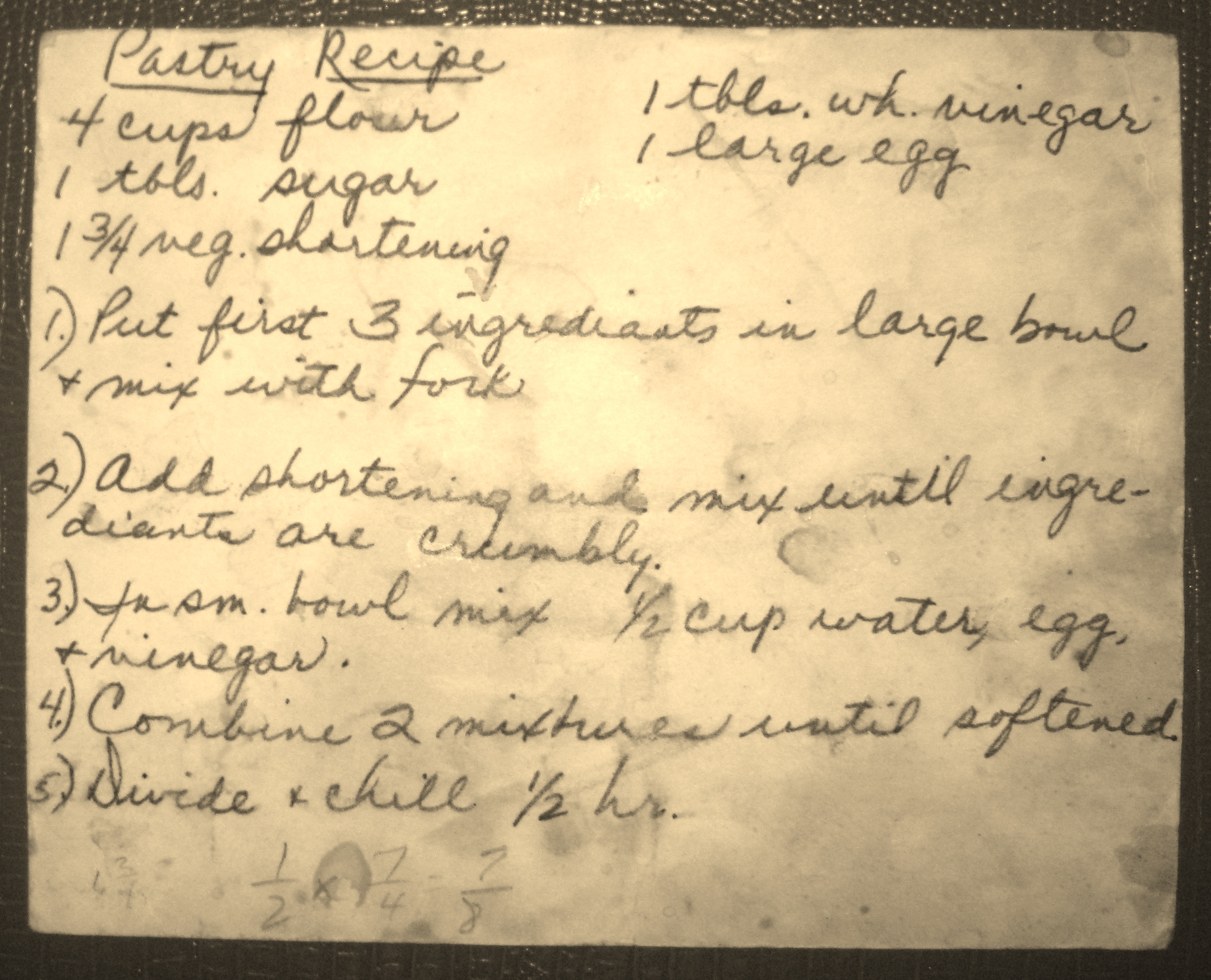
A few weeks before graduation, I wrote out the recipe. I thought I’d need the exact amounts if I wanted to recreate Kathy’s pies.

IMG_1934

I can see the card has been used often in the years since I left Kathy and left Cortland even though pies aren’t hard to make. Only five ingredients, six if you count the ice water.

But even talented cooks might read the recipe for Kathy’s crust and fall short. Because it’s all in the wrist and the fingers. Best made when you’re laughing, or sharing a childhood secret. And letting a slow, delicious afternoon wash over you. And never forgetting  it.

Why I Prefer the Word “Fib”

In my first semester at college — what I laughingly referred to as the real world — communication with my parents was sparse, as the times demanded. There was only one Sunday afternoon phone call because Long Distance struck fear into my parents’ thrifty hearts. My mother and I wrote letters the rest of the time. Hers have not survived, but because she saved any piece of paper that might possibly shame and embarrass me in future decades, mine have.

And here I’d like to call into service the word fib for what went on in my letters. It’s a fine word. By relocating to a state college 250 miles away from home, somehow I felt I’d moved to a different planet. I was living a life I knew my parents could never understand. So a little fiction was called into action so they wouldn’t worry. It was for their own good.

* * *

By October I was stretching the word fib to its limits. This letter preceded a weekend trip home, fall of freshman year.

My Letter:
I’m not sure if I’ll be able to leave for home on Friday night or if I’ll have to wait until early Saturday. Dr. Tomlinson is telling us tomorrow whether we’ll have class that afternoon.

The Truth:
I hadn’t been to Dr. Tomlinson’s class since the first week of the semester. I had no idea if we had class on Friday. I couldn’t have identified Dr. Tomlinson in a lineup.

* * *

Apparently, in the middle of all my other tall tales, I told them that lots of boys were asking me on dates, but I was putting schoolwork first. They chided me a little, saying that I should go out more and have more fun.

My Letter:

I really think studying is more important than boys right now. Sorry I’m not dating or dancing on tables as much as you think I should. That probably sounds snotty but it wasn’t meant to be.

The Truth:

I’d known a lot of dancing. I’d conquered a few tabletops.

And it was definitely meant to sound snotty.

* * *

Early on, I fell in love with a lacrosse player. He was sort of a legend.

My Letter:
I don’t think it’s fair that you’ve judged Nick without meeting him yet. Lots of boys in college have nicknames. He’s not wild! He’s a good person.

The Truth:
His nickname rhymed with Nick. If you’re doing it in your head, any one of the possibilities will work.

* * *

Finals went on first semester in spite of my prayer for a tornado to touch down on the Old Main building the night before. I didn’t want anyone to get killed, of course. Just enough of a funnel cloud that my professors’ grade books would be destroyed for all time.

My Letter:
I can’t believe how hard I’m working! I studied all day Saturday and most of Sunday. I’ve really turned a corner. If all goes well, I’ll have an A in at least one course!

The Truth:
Dear Parent:
Enclosed you will find a copy of the Low Grade Summary Report sent to your son/daughter. He/She is already aware of his/her standing in these courses and will be instructed to meet with his/her advisor. You may be assured that we are concerned, and we hope that the quality of your student’s work will improve.
Sincerely,
Maxwell O’Donnell
Assistant Dean

[Dear Reader: I’ll be back next Thursday, July 16th. Thanks for being here. Really.]

Freshman Year in College. What could go wrong?

After I was all moved into my college dorm, my parents took me out to eat before they braved the five-hour trip back to Long Island. My father made a little speech that I thought contained too much advice I wouldn’t need. Then they got in their station wagon, and I waved to them from the sidewalk. I was on my own, a college freshman, negotiating through one of the most turbulent years in American history — 1968. What could go wrong?

Once all the college orientation exercises were over — after we’d been on campus a few days — classes started. I was afraid that might happen.

Let’s be clear. I wasn’t against learning. I simply had other priorities, and there were just so many hours in a day. I seemed to be driving young men crazy, a new phenomenon for me. The more I attracted attention, the better I got at it. It was almost mathematical. Or — to put it another way — I probably would have been picked first or second in Square Dancing if such a thing existed in college. Definitely in the top five.

Although Cortland was still steeped in traditions like fraternities and panty raids, the undercurrent of social change was undeniable. I first noticed it inside the classroom.  I’m sure my parents thought they could count on strict rules about attendance and grading in exchange for the tuition money they were shelling out. But the old rules weren’t resonating with younger teachers who were walking into class, their hands in their pockets and humming Dylan tunes.

One of them, a young man who taught English 101, would come in late and sit cross-legged on his desk and say, “So, what do you guys want to talk about today?” The answer was hardly ever subject-verb agreement.

Another started the semester like this: “I don’t believe in taking attendance.” Now this was a system I could work with.

Unfortunately, these same professors who seemed so cool still believed in midterms and finals. And in November, when that first exam loomed, I discovered it was much harder to absorb 250 pages of text in one sitting than I thought. I cracked the virginal binding of my Sociology book at 11 PM the night before my 9 AM exam. Within an hour, I was erupting in sobs.

My roommate, Randi, heard me — perhaps the reason I chose space in the hall, right outside our room. She padded out in her bathrobe and fuzzy slippers. She was taking the same course with the same professor but had chosen a different route early in the semester. At first her attention to detail had annoyed me.

After dinner, she’d say things like, “See you later. I’m going to the library.” Sometimes she actually used the word homework, and I’d want to shake some sense into her.

“Come on,” I’d think, as if she were a little sister who didn’t know any better. “We’re in college. There is no homework in college.”

This night made it Randi’s turn to talk. She sat down in one of the lounge chairs.

“I have outlines,” she said softly. They’ll help us. Don’t cry.”

And 47 years later I can see her fuzzy pink slippers.  And hear her say, “Okay, so let’s start with an independent variable…”

For Ron Kovic, on Memorial Day

“I don’t like this,” my mother said as she set the dinner table. “It’s getting to be a bad habit.”

The rest of my family out-voted her. So my brother placed the portable black and white TV on a snack table in the corner of the kitchen.

It was fall, 1967, and I was a senior in high school. Between bites of dinner and sips of milk, my family watched the news unfolding from Vietnam. As a student who thought history was her best subject, I was interested in the logistics of it all, the politics. My ability to watch young men being ripped apart on a 16-inch screen and then say things like, “Please pass the potatoes,” evidently didn’t bother me.

Then Ron Kovic got shot.

Ron Kovic grew up one block over and two blocks up from our house. He and his friends were a staple of my childhood. For one summer I worshiped his broad-shouldered body as he played ball every day in the neighborhood. He was — as were many others — the older boy who never looked my way. For three hot and humid months that year, I made up a reason to walk past his house ten times a day. I hoped for a “hello.” I never got a nod.

I’d lost track of him when he graduated from Massapequa High School in 1964. I had no idea he’d become a Marine. His little sister was at our bus stop on Broadway, but by the rules that governed bus stop protocol, I couldn’t talk to her because she was younger.

And then one afternoon in January, 1968, I saw his sister sobbing on the bus ride home from school, hunched over in her seat. Her friends crowded around her, and I heard one of them say, “Her brother got shot in Vietnam.”

Starting that day, I had two images of Ron Kovic that I couldn’t reconcile. In the first, he wore his letter sweater with the blue and gold M. He had a crew cut and was tan and smiling. In the second — only a few years beyond that — he lay in St. Albans Naval Hospital, paralyzed from the chest down.


Ron

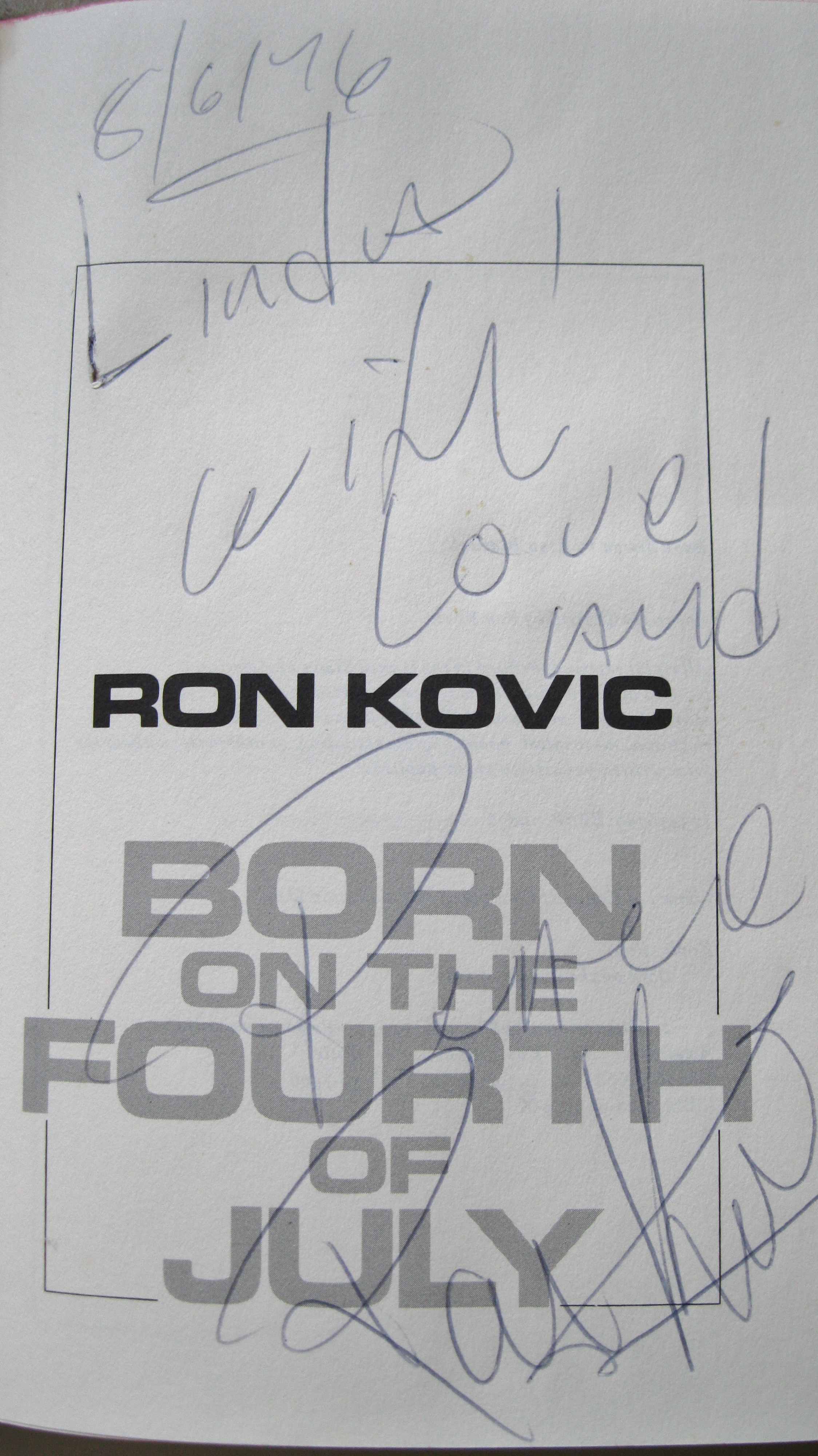
In 1976, when Ron wrote about his life in Born on the Fourth of July, he graced the front page of The New York Times Book Review. He was renewed, strong in his anti-war convictions, still handsome. My brother bought a copy of the book for me and walked around the corner to the Kovic’s house and asked him to sign it.

“He was very pleasant,” my brother told me. “We talked for a long time. I asked him, but he said he doesn’t remember you.”


IMG_1904

When you’re the cool kid on the block, you don’t recall the skinny 13-year-old in the shadows, even if she is adoring your every move. And that wasn’t the big role Ron Kovic was going to play in my life anyway.

January, 1968, my family stopped watching the Vietnam War unfold on the TV screen at dinner. I no longer needed Walter Cronkite to shepherd me through the Tet Offensive or the DMZ. Ron Kovic — that beautiful boy from Toronto Avenue who did perfect handstands — took over the job.

If I questioned what war was, or what it did, my answer was close by now. Two blocks away. At the bus stop. Every morning when I looked into his sister’s eyes.


Yes, There Were Panty Raids

“I love being in charge of my own life!” I said these words aloud my first week as a college freshman. I’m so grateful the Internet didn’t exist, so I wasn’t able to carve that sentence into the memory of the Universe for all time.

The details of my newfound freedom? My parents paid all my bills and gave me spending money. The Residence Hall Director made sure I was in my room before curfew. The dining hall staff cooked my food and washed my dishes. Old women, who worked at $1.60 an hour, laundered my sheets and towels. But I was in charge of everything else.

It was fall of 1968, and on other campuses the unrest of that tumultuous year had captured students’ attention. The assassinations, the war, Nixon’s election. At Cortland, not yet.

At Cortland, social traditions that had been in place for 50 years were still holding on. You could count on those customs. Somehow, they promised life wasn’t about to take the severe bump you feared it might.

My favorite was the ritual of getting pinned. He brought his entire fraternity to her dorm, and they assembled as close to her window as they could. They chanted the girl’s name until someone in charge said it was okay for her to go outside. The boys dressed in jackets and ties for this, and serenaded the girl with songs like, “Let Me Call You Sweetheart,” and other tunes left over from the Herbert Hoover administration. Wearing your boyfriend’s fraternity pin meant that everyone knew you belonged to him.

On Wednesday night of my first week at school, a loud group of boys congregated outside our dorm. I opened the window, and heard, “We want Sue! We want Sue!” I ran to the lounge to tell my roommate, Randi.

“Quick!” I yelled, “Some girl named Sue is getting pinned!” Randi was studying, but she obliged me. One week in, and she was on her way to Dean’s List. I had become an expert on a bygone ritual in its last gasp of life.

We looked down at the growing crowd. I noticed the boys were all in shorts and t-shirts, some in bare feet, not the jackets and ties I loved. And they weren’t singing in harmony.

Randi listened. “They’re not shouting ‘We want Sue.’ They’re shouting, ‘We want silk.’ It’s a panty raid.”


panty-raid


Soon dorm windows on every floor opened, and bras and panties of all sizes (all white) began floating down, like a weird nylon snowstorm. For the second time in days I was overwhelmed at how exciting college could be. First pinnings, now panties thrown out windows. I wondered what miracle Thursday would uncover.

I wanted to be part of the fun, but I suspected my mother had labeled all my underwear discretely somewhere with permanent marker. I couldn’t chance it.

When it was over, boys walked back to their dorms, some wearing bras on their heads as their rewards. They slapped each other on the back and twirled panties in the air.

I wondered what they did with all the underwear.

I had so much to learn. But I’d get there.

The Girl Formerly Known as “Brillo Head”

To understand how surprised I was on my first day of college,

EK_0017
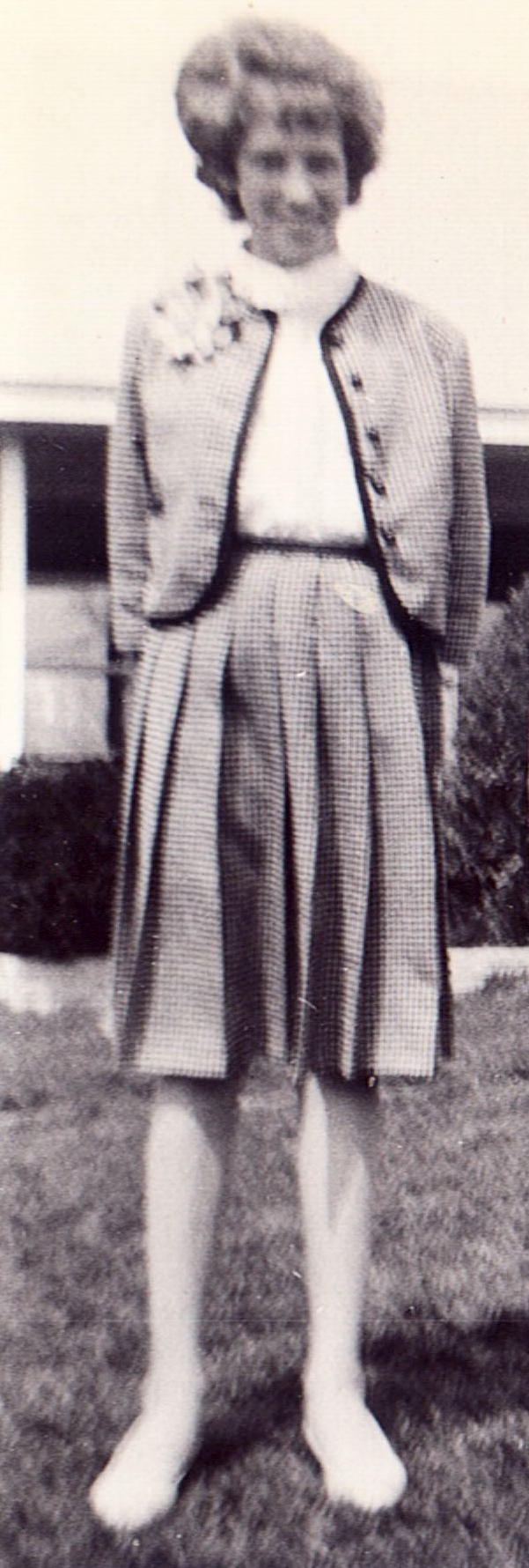
you needed to know me at 13.

EK_0037

A lot went on in those five years between 8th grade and my first day as a college freshman. Maybe ours was the last generation to have suffered through so much awkwardness in one lifetime. These days, girls at 13 are adorable. Maybe it’s hormones in the meat or global warming. Whatever it is, I’m happy for them.

All I know is that it took me a long time to climb out of a space where neighborhood boys no longer saw me coming and began collaborating on what name they would shout out. By my 16th birthday, my public humiliation phase seemed to be waning.  I felt I had a future as someone’s girlfriend, but most of that was wishful thinking.

In summer 1967, my mother and I were doing college tours. We were on a country road in upstate New York. We had left one state school (Oneonta) and were on our way to the next (Cortland). The radio reception was pitiful, but I kept trying, my hand on the dial. All of a sudden, there was Jim Morrison singing, “You know that it would be untrue . . . you know that I would be a liar.”

This was a little racy for my mother, and I knew it. I thought of changing the station. But I figured her mind would be elsewhere and she’d be tuned out long before Jim wanted me to light his fire.

No such luck. She was listening, and the lyrics jolted her.

She attempted an impromptu talk, the kind where I tried to get the car seat to absorb my body and pretend this wasn’t happening. What she came up with surprised me though. It was much different than her lecture after the “Your Changing Body” movie in 6th grade. That talk had zeroed in on what was about to happen to parts of my body I hadn’t yet located.

This one was oddly vague.

Boys could certainly be a problem, she told me, but she didn’t think they would be a problem for me. My mother hadn’t yet noticed that I was no longer standing in the shadows at dances. She was still bracing for some mean boys to call me names connected to smelly zoo animals. Or — their perennial favorite — “Brillo Head.”

And even though my hair was now blonde and shiny, and no one had called me ugly for a long time, I wondered if she was right.

Freshman move-in day at Cortland State –September, 1968 — was sunny and warm, with no inkling that in six weeks it would be snowing. Football and soccer players were given the day off from practice to help freshman girls move in. They were a swarm of handsome, affable types, dressed in jackets and ties.

“Please, let me take that box for you!” His name was Jack. He was talking to my mother.

“Oh, that’s so sweet!” She giggled. Really. My mother giggled. We were getting on the elevator in Alger Hall when he told us he played soccer. By the time we got up to my floor, she was saying, “Oh, you’re a goalie!” There were several trips up and down, during which Jack never let my mother carry anything heavier than a bottle of shampoo.

When we were finished, my father pulled a dollar from his wallet. “Oh, no sir. Thanks, but not necessary!”

Then he turned his attention to me. “You should come to our first game on Saturday. It’s at two. I’ll look for you.”

My parents — off to the side and listening intently — beamed.

Jack shook my father’s hand. My parents looked over at me, as if to say, Well, isn’t he a fine young man. He would never do any of the things we didn’t think it necessary to tell you about because, well, we weren’t prepared for this particular moment.

Their little Brillo Head had finally made it. They weren’t worried. Not one bit.