Back from “The Real World”

Central New York has the same joke as Wisconsin and Minnesota. “We have two seasons: winter and bad sledding.”

It’s not true. Spring and summer are magical where I went to college, and that’s good because it helps you overlook the jolt you feel when the sleet arrives full force after Labor Day. I arrived back on campus in late June, relieved to be finished with the complexities of life in the city, and ready to tackle summer school. My roommate, Julie, wouldn’t be at our apartment until September, so for the first time in my life, I was living alone.

If you’d known me as a freshman or sophomore, and we happened to meet on campus that summer, you would have been able to see I was no longer the shallow coed who flitted from boyfriend to boyfriend. Mostly because I would have told you so. And for anyone who remembered my short-lived Power-to-the-People phase, I would not have screamed in your ear about Nixon’s war machine either.

I may, however, have been a little too full of unsolicited advice when it came to what I’d learned over the last year in New York City, or — as I called it — The Real World. Walking to class or in the grocery store, I found lots of people who knew me, and I never seemed to be at a loss for words. I noticed no one ever said, “Wow! Fascinating! Why don’t we go for coffee later and you can tell me more about how you’ve conquered the universe?”

Eventually, I came to recognize the bored looks on people’s faces and figured I had summer session to get my feet wet in a new style of shutting the hell up.

My apartment was a fraction of what had been an enormous house at the turn of the twentieth century, probably full of children and the small staff needed to run a proper home. It stood at the top of a hill on Prospect Terrace, a name just full of all the gilded-age optimism rich people had. This neighborhood was once full of business owners or the town’s best doctors and lawyers. The slate roof had long ago been replaced with something cheap, and now the paint was peeling, and the evergreens hugging the front porch were rangy and overgrown.

By the time I moved in the summer of 1971, the house was a conglomeration of apartments and single rooms for rent, with suspect wiring and kitchen cabinets bought at auction. I didn’t care if the corners were dingy. I didn’t care that it seemed I was the only one living in this three-story mansion, except in the middle of the night when the wind blew and the house groaned.

The first week went off without a hitch. How many times in my life have I said that? I went to my new classes, bought the books, and settled in. Nothing to it. I spent early mornings sitting on the steps off the back porch, drinking instant coffee in a handmade mug with a broken-off handle. I kept the music — usually Laura Nyro — turned up as loud as I wanted. I looked forward to afternoons hunched over my typewriter, making sense of convergent validity for my Child Psych paper, and I wondered why I hadn’t done it this way from the beginning.

After my first tests, I called my parents with the news. “I got an A on both of them!”

I’m pretty sure they misheard me and thought I’d won the Nobel Prize for Literature because their reaction was way over the top. The year I’d spent as a college dropout was tough on them. They would be overly thrilled at every increment until the first notes of “Pomp and Circumstance” rang out two years later and I marched into the field house in my cap and gown.

I started to wilt in Week 3 of this new life. How many times have I said that in my life? It was late afternoon, and I was reading the paper on the back porch. I’d gotten used to the silence from being the only tenant in a house with 20 rooms. But then I started thinking how nice it would be to share these summer nights with someone. And by “someone,” of course, I meant a man.

An hour later, I heard something come up the winding gravel driveway. A pickup truck rumbled into view and cautiously made the right turn behind the house, toward the bank of garages that had once been a carriage house. Evan Callahan turned off the engine and jumped out.

“Greetings!” He said the word as he moved his entire forearm in a semi-circle.

He would be living here, too, in an apartment on the other side of the house from mine. His was a small studio he was going to share with a roommate, who wouldn’t be in town until September either. So now there were two of us, and I liked the idea. With creaking walls on windy nights, it would be nice to know I wasn’t alone. And now if I found mice in my kitchen, I’d have someone to kill them for me. The Real World hadn’t taught me anything about rodents.

I said, “I made some stew. Are you hungry?”
Chickenhearted? Yes, Guilty

My two biggest childhood fears were long shots at best: bear attacks and appendicitis. Since my neighborhood was built in 1950, every tree, bush, and errant twig were leveled to fit as many Cape Cod houses on a block as possible. I barely saw a squirrel.

Appendicitis never got any closer to me than the boy across the street, who was rushed to the hospital by ambulance after hours of crying in mysterious pain. He was carried out his front door on a stretcher as we congregated and watched in horror. Later we heard this organ we hadn’t even known existed had “exploded” inside him. Although he recovered in a few days, I knew it was just a matter of time before appendicitis came looking for me, too.

I grew up and my fears changed. Then they changed again. Now I look around and — is it just me or — are there more and more things to cause concern? Diseases that start out with a little innocent tingling in your foot. Isis. Choking on a cough drop. Tsunami. Salmonella. Snakes. Wild fires. And what if you really do fall and you can’t get up?

I am guilty of being chickenhearted.

Like this: I called for a cab at 6:30 AM, and here it is. Why do I look at the cab’s tires before I get in? I tell myself although — yes — they do look bald, I’m sure cab companies have standards. The inside of the cab smells like vomit. Once we’re on the highway, I can see the speedometer reaching insane speeds.

I say, helpfully, “We’ve got plenty of time for my flight. We’re good on time.” That’s as direct as I will get because the driver is scowling now. She eats her breakfast  — a bag of Doritos and Diet Coke between her legs — as she steers with her left index finger and thumb.

“Have you worked all night?”

“Yep.” I could hear my family saying, “Bald tires and excessive speed, and it appears the driver may have fallen asleep while eating,” when people at my wake ask how I died.

But I don’t die, it turns out. So far so good.

I’m taking off my shoes and jacket at Airport Security when an unmistakable smell comes wafting by me. Vodka. This is not the 6-hour old stuff that oozes out of a person’s pores from the night before. This is a freshly slammed-down shot now filling the air. I hope it’s the passenger in front of me in the Hawaiian shirt. I sure don’t want it to be someone whose job it is to look in purses and find knives.

Ever since Amtrak starting saying, “If you see something, say something,” I’m always at the ready to scream, “Here! Here’s something you need to check out!” I give the TSA guy a good whiff as I go by. All clear.

The plane takes off and touches down smoothly, so the luck that’s been with me all my life is still holding. I take a deep breath and tell myself to trust the universe more. Because the only bears I’ve seen lately are on Discovery Channel. And after all these years, I still have my original appendix, which shows no sign of exploding. Of course it’s still early.

[I’m taking a blogging break next week to work on my book, which is nearing first draft stage. See you back here on October 1st.]

He’s About My Age

He’s about my age. His white hair is long and full, but not so much that he looks like he never found his way home from a Grateful Dead concert. I see him walking through the neighborhood all the time.

Today he’s on the other side of the street, and my grandson and I are playing in the front yard. He hasn’t looked in our direction all summer, but now he says something I can’t quite hear.

“Excuse me?” I say.

He bounds across the road so he can repeat his first message, which may or may not have been purposely mumbled just so he could bound across the road.

He begins in mid-sentence. We figure out we both graduated from high school in 1968 and ask the usual questions about where we grew up, where we went to school. He asks about my grandson. “What’s his name? How old is he?”

Even though he didn’t plan this conversation (maybe) he has a lot to say. At some points he’s just lost in his own narrative. At others, his gaze lingers on me, and I wonder if he’s flirting. It’s so hard to know when hormones aren’t flying through the air like they used to.

But yes, I think the neighbor likes me.

“What’s your favorite band of all time?” he asks.

“Rolling Stones,” I say.

He approves of my answer and starts telling me about a movie starring Mick, something I never heard of because — truthfully — I stopped caring deeply about Mick a while ago. In the middle of his story, my grandson decides it’s time for lunch. The neighbor and I say our goodbyes.

Me: “I guess I’ll see you around.”

He: “I guess you’ll have no choice.”

I’m a little uneasy the rest of the afternoon, worrying he might be at his house now, thinking Damn. What an attractive woman. What if the next time I see him he pulls out a Rolling Stones boxed set from behind his back, or invites me to dinner?

A week later, I spot him in the supermarket, on the other side of the produce aisle. My grandson is in the shopping cart seat, facing me, and I pretend to be telling him something interesting about cucumbers because I don’t want to get the neighbor’s hopes up if he sees me. I don’t want to look available, if that’s the right word for the way you can look in a supermarket when you’re this old and getting your grandson in the cart seat is the most physical thing you’ve done all day.

I’m thinking to myself, Ugh, I have to let him know that I’m just not interested. But before I know it, he has seen me, crossed over, and is standing in front of us, grinning.

“Oh, hi there,” I say.

He smiles big. He motions to my grandson and asks, “How old is he?” I’m a little confused. “What’s his name?” he asks. Again, old news, but I tell him.

I realize it’s not that he’s a bad listener and has forgotten the details of our talk on the sidewalk. He has no idea who I am.

On the way home, with my grandson chirping happily in the back seat about the cookie the bakery lady gave him, I feel the need to reach deep into my memory box.

I was 23, at a wedding, seated next to a man from Greece. He was dark and tall and brilliant. We danced. I’d had a lot of wine and had suddenly remembered what a fabulous dancer I was. At the table, as we talked, he looked deeply into my eyes, and we took almost-drunk turns being fascinating.

Hours later — home alone and in bed — I heard little pebbles glancing off my second-story window. He was standing in my front yard, bathed in moonlight.

“We’re not finished,” he said, “I want to know more.”

I go over the story a few more times — savoring a detail here and adding a new one there — until finally I’m ready to take it into old age with me.

“How’s that cookie?” I ask my grandson. I’m happy the rest of the way home.

The Cellist’s Wife and Me

Paul and I started looking for our own place for a couple of reasons. Paul’s mother rolled her eyes at everything we said. We were getting snubbed in the elevator, even by the man in the uniform whose job it was to make chatty small talk and push the buttons for us. We were done with the Apthorp.

We saw ourselves baking bread and sweating out hot nights in a crumbling walk-up apartment in the East Village where garbage pick-up might be iffy. But those apartments were scarce.

Finally, Paul’s mother called in a favor from friends, a couple she knew about 20 blocks away. He was a famous cellist and they owned a second, smaller apartment in their building, which they’d bought for their daughter. But she was in Barcelona, taking pottery classes and drinking white cava in the afternoons, and it didn’t look like she’d be home soon. It was ours to rent.

The good news: it was closer to Columbia and Harlem.

The bad news: it was on Riverside Drive and the cellist and his wife were filthy rich. We couldn’t lose a doorman or an elevator operator no matter what we did.

Paul was pleased that at least our apartment only had two windows. They faced the brick wall of the next building, a few feet away. It always seemed like it was 4 PM on a cloudy day no matter what the weather.

We were firm in the set-up of our new space. No furniture in the living room, just a few mattresses, so we could invite friends in to discuss anything that needed discussing and give them a place to sleep if they needed one.

After a few weeks, even Paul tired of the dreariness, and we tacked up some posters. And once the walls didn’t look like a subway station anymore, we bought Indian print bedspreads for the mattresses. We thought a chair or two wouldn’t really make us total sell-outs, as long as they weren’t comfortable.

Paul still wanted to pretend we were living in a corner of the Port Authority. The irony weighed on me in a pre-war building with a doorman, but six months into the relationship, I had a deep-pocket investment. I had dropped out of college to be with him, much to the anguish of my parents. They wondered if I’d ever amount to anything without a college diploma. They didn’t love the sex part either.

Once a month I took the elevator to the top floor to pay our rent. The cellist’s wife always seemed to be cooking when I arrived, often wiping her hands with a dish towel as she answered the door.

“Let me get you a receipt,” she’d say as she padded barefoot to her desk. This always gave me time to study the photographs on the baby grand piano, arranged in a clever pattern that made you think it was haphazard. One was of the cellist standing arm in arm with Pablo Casals on a beach. In another he was shaking hands with President Kennedy.

Their living room was full of leather sofas and cozy armchairs upholstered in yellow and blue patterned stripes and checks. Tall potted plants soaked up all the sun that came through their windows. I thought of asking her if I could pay the rent every two weeks — just to be in that space more often and absorb her graciousness — but I sensed it would be taken as weird. And more than anything, I wanted her to be happy to see me on the first of the month.

When word got out we weren’t living at the Apthorp anymore, Paul’s friends from all parts of the country began knocking. Some would stay the day, but others might still be underfoot a week later.

By early spring, everything about Manhattan exhausted me. I hated crowds, I discovered, which made sharing a small island with eight million people a little tricky. While Paul still wanted to cure the world, I’d discovered walking through Bloomingdales at lunchtime did wonders for my middle-of-the-day blues. And then there was my platonic love affair with the cellist’s wife and her glorious living room.

One night someone named “Chicago Tom” was giving a mini-lecture about the travesty of the Yale University endowment. He was eating the last of the chili I was hoping to have for dinner. I went to the bedroom, closed the door, and turned on “Let’s Make a Deal.” The discussion from the living room droned on. I was hungry. My days in the Revolution were over.

The next morning I said out loud what I’d been thinking for weeks. “I’m tired of your friends.” It didn’t go over well.

I decided a college degree wouldn’t be such a smudge on my character after all. I called my parents.

Two weeks later my father — on time as always — pulled up in front. I would stay with my parents for a few weeks and then get back to Cortland for summer school. We started loading my belongings into the back of the station wagon. I was weepy. Paul was, too.

“Maybe we should reconsider,” one of us said, but I don’t remember which one. He let go of me. I got in the car.

My Parents Called 1970 “Ugh, That Year”

The last date I had was a set up. According to our mutual friend, who arranged it, we were a perfect match.

The first thing I notice about my date is how seriously he takes his martini. His order comes with three instructions, and he warns the waiter he’ll be able to tell if any one of them hasn’t been followed. Why would anyone take liquor so seriously? (thought the woman who drinks wine out of a box). Or — to put it another way — this may be yet another man who won’t get me one bit.

He says, “I’ve just moved back to Baltimore after many years in Manhattan.”

I say, quietly, “I lived in Manhattan once, in the early 70s.”

“Oh?” I can tell I’ve interrupted his flow because his response is a bit snappy. Did I mention his ancestors may have traveled over on the Mayflower? Our first six minutes together have led me to this theory. “Where?” he asks but I can tell he’s just being polite.

“Upper West Side. “The Apthorp.”

“Really?” he perks up. He starts throwing out names — one of them famous — of people he knew at The Apthorp. He tells me he went to a few parties there. He orders another drink.

* * *

When Paul Goldberg said, “Wait!” on that sidewalk in Cortland NY, I turned back. And then I walked right into his life. By the evening he was making me tea and we were spilling our secrets.

His plan had been to go to Berkeley, where he felt he could do the most good. After two days of being together, we realized we couldn’t be apart. But there was a pragmatism to our love, too. We sensed my oh-so-new conversion to left-wing politics wasn’t ready for a cross-country move quite yet.

Over toast with grape jelly on our fifth morning together, we decided to relocate to Manhattan — where he’d grown up and his mother still lived. We’d stay with her until we found our own place.

My parents always referred to 1970 as “Ugh, that year.” I didn’t see their point until about 1980. One minute I was the usual college coed, asking for money and fibbing about grades, boys, and how I spent my time. Suddenly I was lecturing them about Huey Newton and male chauvinism. I called them to announce — with gravitas leaking from every pore of my body — my intention to leave school and move in with Paul.

Here’s where they landed: “Just understand you won’t be welcome home for Thanksgiving. Or Christmas.” After that my parents and I went to our respective corners and had a series of miserable conversations that went nowhere.

And soon after that, Paul and I emerged from the subway station at 79th and Broadway, and I took a look at my new home.

The Apthorp is an Italian Renaissance Revival beauty, taking up a whole city block. It comes with iron gates and limestone sculpture and a courtyard rimmed with trees and lamp posts. The men who stood guard at the entrance called Paul by name. The grandness of the place got more in focus the closer we got to his mother’s apartment. The elevator operator in a uniform. Fresh flowers. If I’d been paying more attention in Psychology class, I wouldn’t have been at all surprised that this grandeur spawned Paul Goldberg, Leader of the Revolution.

I kept rubbing my sweaty hands on my skirt as he opened the door for us, sure Paul’s mother was the kind of woman who shook hands when she met you. I was pretty sure she wasn’t a hugger. But maybe she was.

We waited. It seemed a while before she walked into the living room.

“And is this Linda?” She said my name as though she wasn’t sure she had it right. Pretty quickly I knew there would be no need for dry hands. I was not what she was expecting.

“I see you’ll be staying with us,” she said as she looked down at my luggage. “Perhaps my son might have let me in on the secret.”

And that was my welcome to the storied Apthorp building. This signaled the start of my attempt to climb into the bosom of Paul’s family since I was pretty sure mine would never talk to me again.

As I slept that night, ambulances careened up and down Broadway and woke me. I jumped every time. Paul told me I’d get used to it.

Love in the Revolution

What the student strike had in worthy causes — the escalation of the war and the killings at Kent State — it sometimes lacked in organization. With no cell phones and no social media, trying to mobilize people to their respective corners was a challenge. Each speech or every time 50 people walked in one direction on campus took on guerrilla importance.

I reported to my parents that I was learning more from teach-ins and caucuses than I’d ever learned in classrooms. This no doubt pleased them abundantly. They humored me, thinking it was a phase. I dug in harder, adding a new –ism to my vocabulary every few hours. Imperialism, paternalism, asceticism. You get the idea. I don’t think I yet knew the word “dilettante,” which might have slowed my roll a bit.

On the second day of the strike, tensions were high. More speeches. Much more chanting. Fewer peace signs, more angry fists in the air. I was taking a shortcut through the Old Main building and passed by the auditorium just as a loud eruption of applause came through the doors. I should probably know about this, I thought, not having any idea what this was.

Behind the podium was one of the strike leaders. I recognized him by his long curly hair, which I’d admired the day before. Whoever he was, he was igniting this crowd. His wire-rimmed glasses rested on his prominent nose as he spoke without notes. I thought he was brilliant, and — looking back — he may have been. One thing was clear. I’d never passed him in the hallway of a fraternity party.

During one of the audience’s loud chants and extended cheers, I asked the person next to me if she knew his name.

She said “Paul Goldberg” as if maybe I’d spent the semester in a cave.

A couple of days later, Cortland — knowing it had lost control of all the students now yelling, “Strike! Strike! Strike!”  — announced it would close early for the semester. And, in triumph, everyone began making arrangements to leave campus and travel to other places and be radical and revolutionary in locales that mattered more.

I set out to meet Paul Goldberg before he left town.

I was walking downtown when I spotted him a block away. If that sounds one single bit coincidental, it was not. I believe the latter-day word for what I did is classified as stalking, about which there are now laws in place.

He was alone. I began to follow him. I was rehearsing opening lines when he turned onto a residential street. It looked like the part of town Paul Goldberg would live in. A little seedy, but he might call it “being with the people,” or any number of phrases I thought he might say. Then suddenly he took another turn. I realized he was walking to the door of his apartment.

He was five steps away from being gone forever.

“Excuse me.”

He turned, and there I was. All at once I could tell this was new territory for Paul Goldberg. My guess is that never in his life had the pretty blonde girl who dated lacrosse players moved in on him quite so aggressively. Or moderately aggressively. Or at all.

“I just wanted to tell you that I was in Old Main when you were giving your speech the other day. And it was the greatest speech I’ve ever heard.”

It wasn’t much but it was all I had. Specifics or critique would have just gotten me in trouble. I went with the broad stroke.

He was wide-eyed.

“Thanks.”

“Well, that’s it really.” I paused a bit but his mouth was still slightly open, and he didn’t look like he was going to say anything more.

“So, uh, have a good day,” I said as I turned and started back toward Main Street.

With every step I was silently saying, Please Please Please Please. Please, Paul Goldberg, this is our last chance to be together until the end of time. Say something.

“Wait a minute!”

Ah.

[Up next Thursday: The Phone Call That Didn’t Go Well]

It was 1970. I Was Late to the Revolution

My sophomore year in college continued in the tradition of my freshman year. Socially, I was golden. Academically, I counted on short bursts of manic studying with equal parts dumb luck and using my charm whenever I could. By spring, I was squeaking by. Barely.

I looked like the same girl who had arrived on campus two years before. My wardrobe of choice was one of the miniskirts my mother had made me, a matching headband, and a blouse I was sure rendered me “cute.” I slept every night with my hair in rollers so big it was amazing I didn’t throw my spine out of alignment.

April 30, 1970, at the tail end of sophomore year, I decided to get serious about grades. This Hail Mary maneuver happened every semester, but I sensed I was in more trouble than usual. I was studying. But then I got hungry and walked to the Student Union for a slice of pizza.

There was a crowd fixated on the television there. I couldn’t see the screen.

“What is it?” I asked the person next to me.

“Nixon just invaded Cambodia.”

Lots of short sentences have changed the course of my life. “Let’s get married,” was one. “You’re pregnant,” was one. “Try it,” was one.

“Nixon just invaded Cambodia” is up there with all of them.

Here’s where I go off on a little tangent about my generation’s place in history. This is what makes Baby Boomers annoying to anyone who came before or after us. But the truth is, when we were teenagers, so much came shooting at us all at once. Things gave way.

The war had been going on since we were in junior high school. Most of us knew someone — or knew someone who knew someone — whose life had been thrown into utter chaos because of it. Some had a closer view of the loss. Some were the lost.

All of this happened: Four girls killed in a Birmingham Church. Protestors crossing the Pettus Bridge. Goodman, Schwerner, Chaney. The March on Washington. Stokely Carmichael rose up and shouted “Black Power” for the first time.

My senior year in high school witnessed the death of Martin Luther King, Jr. and then Robert Kennedy nine weeks later. Trusting the universe, something 1950s kids were really good at, became harder to do.

And as women, the role we’d been taught to believe was coming our way was not coming our way, it turned out. We would not get married weeks after college graduation. We would not become housewives and have babies in our early 20s, the way our mothers had. And we’d have a lot more sex. Our mothers did not like that part at all. So we felt jubilant some of the time and guilty the rest.

As soon as Nixon announced the invasion of Cambodia that night,  several groups — all with differing agendas — started forming outside, loud and angry. They ranged from “America, Love it or Leave it” to a less structured group chanting “Drop Acid, Not Bombs!” And a few in between, with messages harder for me to glean. It was a political smorgasbord. I had a lot of catching up to do.

In the next few days, I listened to speeches and read as much as I could. I irritated friends by lifting slogans, sometimes complete paragraphs, from works I didn’t fully understand. I wrote my parents terrible letters about how horrified I was that we were middle class. My mother wrote back: “Would you rather be upper class or lower class?” and I screamed at her into the phone that she’d missed the entire point — in fact she missed every point of my entire life.

Cortland, like almost every campus in America, had upended. We were officially on strike. I had a fleeting moment of worry about my grades. As always, I’d been counting on a miraculous showing during exam week to carry me through. Finals wouldn’t happen now.

I had to put aside childish worries, like grades or what my parents thought. I had more serious commitments now, a revolution to join. I jumped. No parachute.

[Next Thursday: Love in the Revolution]

My 7-Word Brush with Helen Gurley Brown

The phone rang while I was making dinner. My kids were underfoot. It was 1986, we didn’t have Caller-ID yet, and I always suspected telemarketers at that time of day. I tried to answer with an attitude, making it clear we didn’t need new windows or a timeshare in Jamaica.

The voice on the other end was low and commanding, and her name was Myra. She was a senior editor at Cosmopolitan, following up on a query letter I had sent a month before. She was quick and to the point.

“We’d like to hire you to write the article you’ve proposed. We can offer $3,000 with a kill fee.”

I was not yet calling myself a writer back then for fear I would be outright lying. I was piling up meager checks here and there, mostly from parenting magazines and newspaper op-eds. When she said $3,000, I was conscious of not hyper-ventilating into the receiver.

I had queried Cosmo about an article idea I knew nothing about — not unusual for me back then (or now, come to think of it). The topic was the relatively new phenomenon of single career women deciding to have a baby on their own, without a husband or even a boyfriend in their lives. Tame by today’s standards, there was a time when this was groundbreaking.

Myra wound up our conversation with this: “The first draft will be due in six weeks. Of course Ms. Brown will have final say. I’ll be in touch after she reads it.”

I got off the phone, positively giddy. Then I realized Ms. Brown was Helen Gurley Brown. And my knees shook a little.

The next day, I began my research. Since email was not yet the communication of choice, I did everything by phone while my kids sat in front of the television, eyes glazed over by Gilligan Island reruns. It was not my best mothering moment, but — hey — I was going to have a byline in Cosmo.

I felt a connection to the women I interviewed even though I’d gone the conventional route toward motherhood. They were smart and savvy. Their stories were poignant, about their dreams to have a baby, about running out of time. Myra had made it clear in our first conversation that the magazine did not approve of this new way to form a family and my piece should reflect that slant.

I thought I knew better. On the day I put my draft in the mail, I believed I was going to make journalistic history. A few days later, the phone rang. It was Myra.

“We received your draft and Ms. Brown has seen it.  I’m going to read from her memo.”

Here is what Helen Gurley Brown thought of my draft: “This writing is smug, small, and sanctimonious.”
I’ve always loved the idea that she brought forth alliteration to cut me off at my writing knees.

Here’s the good news. There was a kill fee waiting for me that exceeded my wildest expectations. I thought HGB was wrong about my writing, but I still had some wounds to lick. So I licked them. And I developed a clever answer for  friends who kept asking when my article was going to appear in Cosmo.

And the bad news? There wasn’t any. My keyboard was still waiting for me in the morning, with all its possibilities. So I sat down. And I got back to work.

General Hospital, Baking Pies, and Why I Never Made Dean’s List

My list of college accomplishments was short. I was guilty of falling in and out of love hard and spending too much time in front of my mirror. I didn’t have a clue how to balance a check book or to begin writing a term paper any sooner than the night before it was due. All true.

But thanks to my cousin, Kathy, I learned to bake a pie while I was in college. I’m putting that down as my #1 achievement, sad as that may sound to those of you who made Dean’s List. I’ll own it.

As kids, Kathy and I grew up a few miles from each other on Long Island. We shared family meals and holidays. We spent shimmery afternoons playing hide-and-seek in the apple orchard across from her house. Now, by coincidence, we had both relocated to Cortland. I was a student (at least some of the time), and she was a young wife and mother.

I’ll blame this on her, but it surely could have been my fault: Somehow, we got hooked on General Hospital.  Since I didn’t own a TV, I would stop by her apartment a few afternoons a week to see what was happening in Port Charles. She would put her son down for his nap. After the scintillating dialogue and plot twists had consumed an hour, we’d tiptoe past her sleeping toddler’s room and go to the kitchen.

She would make a pie. I was her helper, doing the easy jobs, like whisking the flour and sugar together or coaxing ice water from cubes. Kathy would use her pastry blender to cut in the shortening. Then her fingers — quick and deliberate — to form tiny pebbles of dough before she would begin drizzling in the water.

Kathy came from a home where my aunt made everything from scratch, even brioche French toast. My mother was most comfortable reaching for an easy fix in the freezer and had a whole comedy routine about it. She called herself “The Swanson family’s best friend.”

Kathy was also the cute one — blonde and perky, and a cheerleader. I was the spindly one who took forever to grow into her stork legs. Then, in our late teens, it all changed. She married young and had a baby. I went off to college. As I was making fraternity parties and football games my full-time endeavor, Kathy was planning casseroles on a budget and researching preschools.

“I think I’m going to break up with Paul,” I might say as we baked on those lazy afternoons. She would already be crimping the dough into the pie pan as I was still going through the merits (or shortcomings) of Paul, or Tim, or Peter. She kept them all straight, a credit to her cousin love.

She talked about toilet training, and I tried to add comments where I could. We told stories about our mothers. We worried General Hospital was turning our brains to mush, but admitted we couldn’t give it up. We’d chat up until the last minute, until her son began calling, “Mama!” from his crib or her husband came through the door after a day of classes.

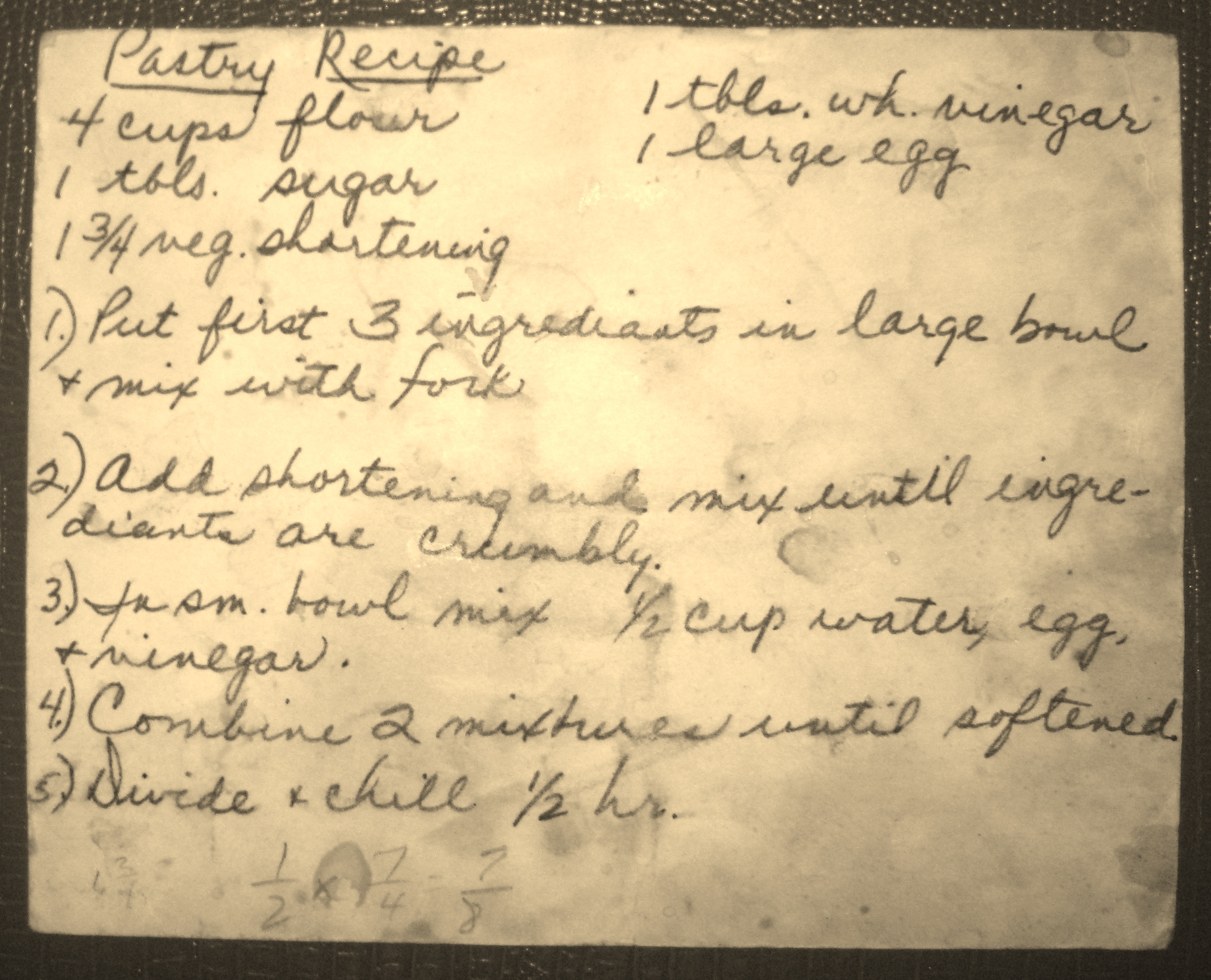
A few weeks before graduation, I wrote out the recipe. I thought I’d need the exact amounts if I wanted to recreate Kathy’s pies.

IMG_1934

I can see the card has been used often in the years since I left Kathy and left Cortland even though pies aren’t hard to make. Only five ingredients, six if you count the ice water.

But even talented cooks might read the recipe for Kathy’s crust and fall short. Because it’s all in the wrist and the fingers. Best made when you’re laughing, or sharing a childhood secret. And letting a slow, delicious afternoon wash over you. And never forgetting  it.