General Hospital, Baking Pies, and Why I Never Made Dean’s List

My list of college accomplishments was short. I was guilty of falling in and out of love hard and spending too much time in front of my mirror. I didn’t have a clue how to balance a check book or to begin writing a term paper any sooner than the night before it was due. All true.

But thanks to my cousin, Kathy, I learned to bake a pie while I was in college. I’m putting that down as my #1 achievement, sad as that may sound to those of you who made Dean’s List. I’ll own it.

As kids, Kathy and I grew up a few miles from each other on Long Island. We shared family meals and holidays. We spent shimmery afternoons playing hide-and-seek in the apple orchard across from her house. Now, by coincidence, we had both relocated to Cortland. I was a student (at least some of the time), and she was a young wife and mother.

I’ll blame this on her, but it surely could have been my fault: Somehow, we got hooked on General Hospital.  Since I didn’t own a TV, I would stop by her apartment a few afternoons a week to see what was happening in Port Charles. She would put her son down for his nap. After the scintillating dialogue and plot twists had consumed an hour, we’d tiptoe past her sleeping toddler’s room and go to the kitchen.

She would make a pie. I was her helper, doing the easy jobs, like whisking the flour and sugar together or coaxing ice water from cubes. Kathy would use her pastry blender to cut in the shortening. Then her fingers — quick and deliberate — to form tiny pebbles of dough before she would begin drizzling in the water.

Kathy came from a home where my aunt made everything from scratch, even brioche French toast. My mother was most comfortable reaching for an easy fix in the freezer and had a whole comedy routine about it. She called herself “The Swanson family’s best friend.”

Kathy was also the cute one — blonde and perky, and a cheerleader. I was the spindly one who took forever to grow into her stork legs. Then, in our late teens, it all changed. She married young and had a baby. I went off to college. As I was making fraternity parties and football games my full-time endeavor, Kathy was planning casseroles on a budget and researching preschools.

“I think I’m going to break up with Paul,” I might say as we baked on those lazy afternoons. She would already be crimping the dough into the pie pan as I was still going through the merits (or shortcomings) of Paul, or Tim, or Peter. She kept them all straight, a credit to her cousin love.

She talked about toilet training, and I tried to add comments where I could. We told stories about our mothers. We worried General Hospital was turning our brains to mush, but admitted we couldn’t give it up. We’d chat up until the last minute, until her son began calling, “Mama!” from his crib or her husband came through the door after a day of classes.

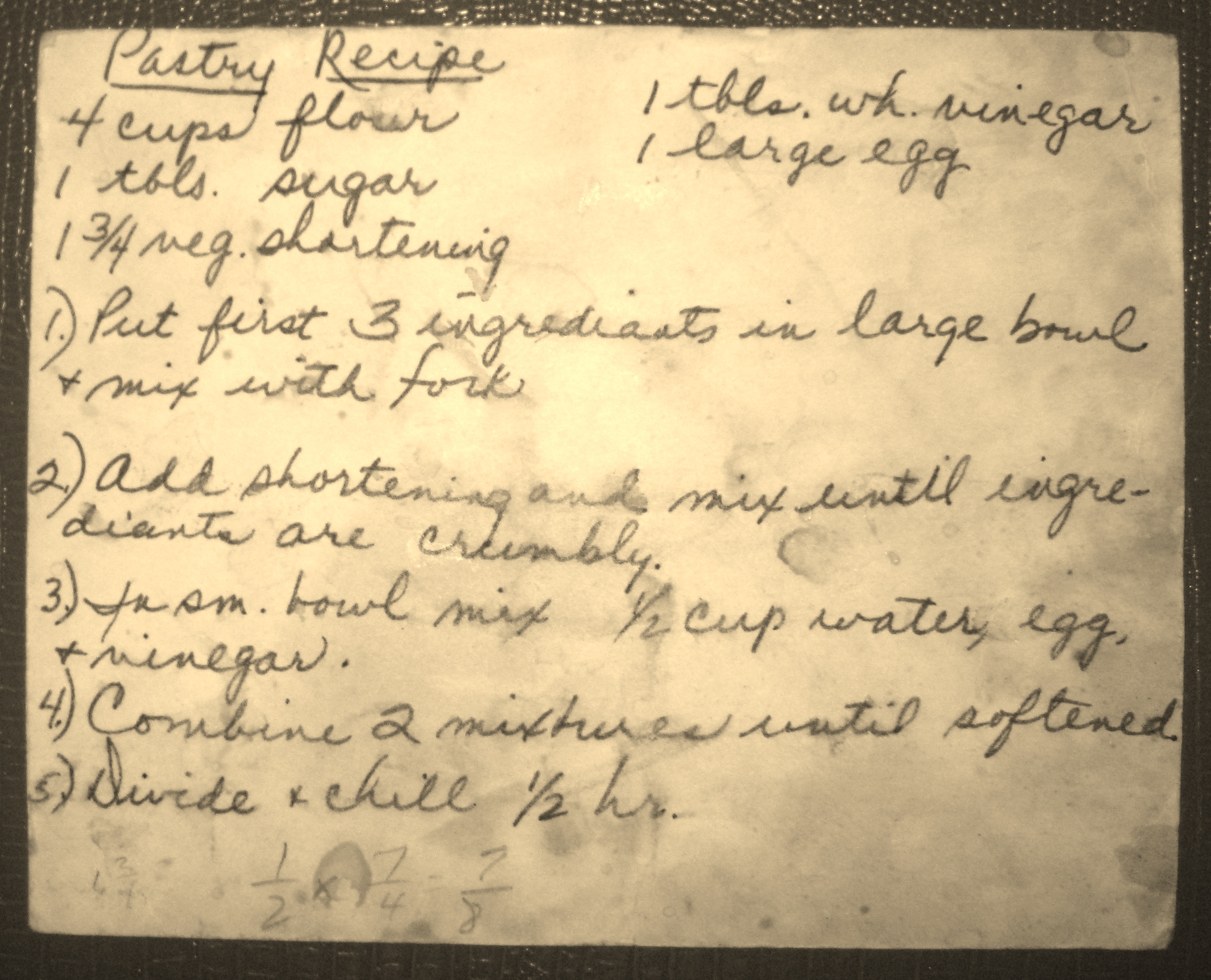
A few weeks before graduation, I wrote out the recipe. I thought I’d need the exact amounts if I wanted to recreate Kathy’s pies.
IMG_1934

I can see the card has been used often in the years since I left Kathy and left Cortland even though pies aren’t hard to make. Only five ingredients, six if you count the ice water.

But even talented cooks might read the recipe for Kathy’s crust and fall short. Because it’s all in the wrist and the fingers. Best made when you’re laughing, or sharing a childhood secret. And letting a slow, delicious afternoon wash over you. And never forgetting  it.
6 Things I Learned from a 1950s Baby Book

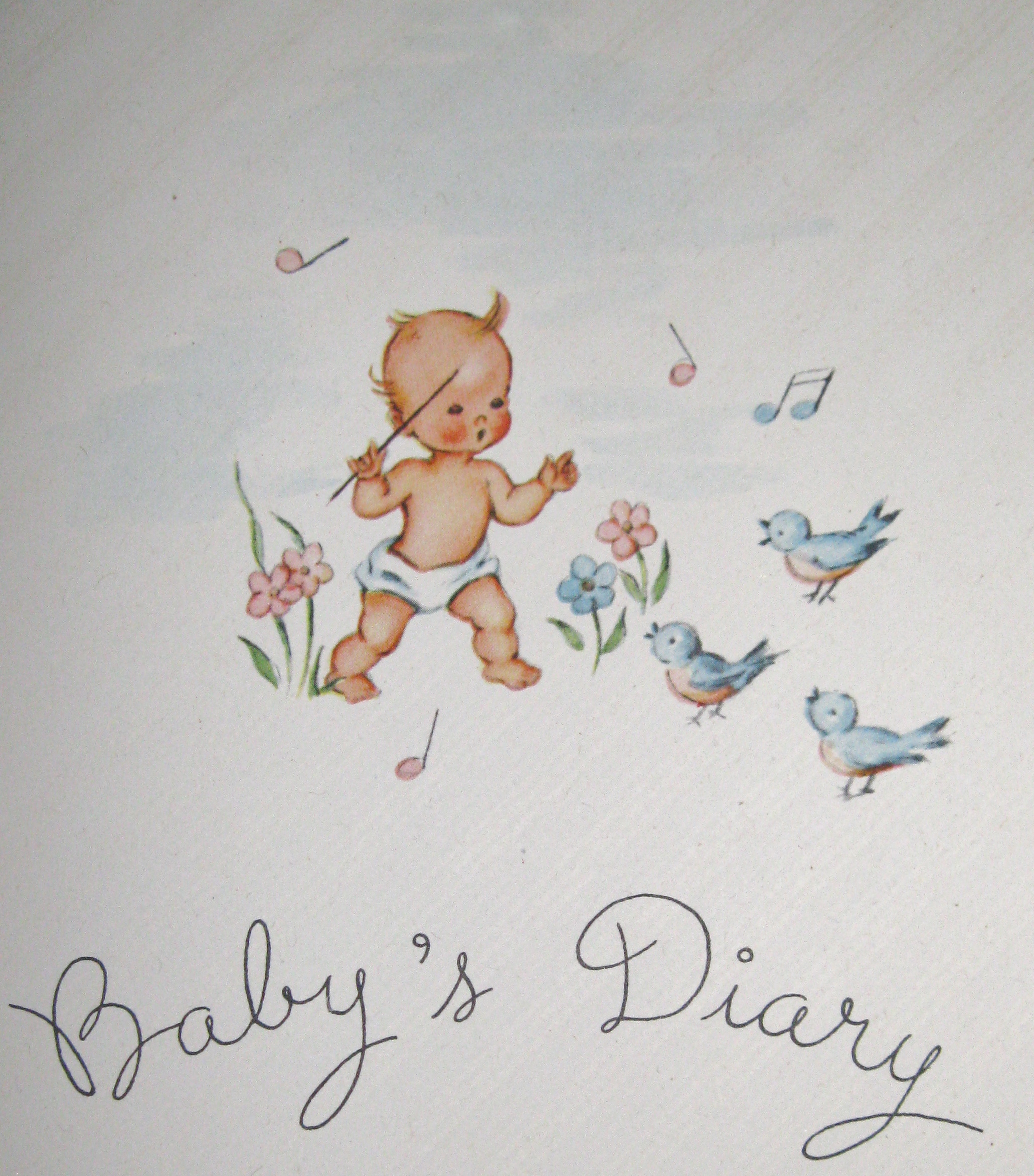
Years ago my mother was visiting from Long Island. With fanfare she rarely called into action, she said, “I brought something for you.” She pulled my baby book — old and worn — out of a Walbaum’s supermarket bag. I could tell she had planned a little ceremony surrounding the hand-off. I tried not to show it, but I was not pleased.

first page

She was being practical. My mother was always practical. She said something about not wanting it to get lost, and then her voice trailed off a little. She was talking about a time when she and my father would no longer pull up in front of my house and stay the weekend. She was preparing for a future when we wouldn’t be able to gossip at my kitchen table over a glass of wine, or catch up on what my kids were up to.

I didn’t like it one bit. I wanted the book to stay on the shelf at her house, where it had always been. I didn’t want to be the grown-up in the family yet. That was her job.

But I took it from her that day. And now the baby book lives on my shelf, with the other three baby books I wrote in (the third one sparingly, my third-born would tell you, rolling her eyes). I don’t know when their books get shuffled off to their homes. Not yet.

I haven’t opened mine in a long time, but I did today. We had a new baby born into the family last week, and every time that happens, it seems like a good time to revisit it. And every time I do, I learn a few things I’d overlooked before.


1. My mother was a stickler for details. But on her first try, she got not only the day of my birth wrong, but the month, too. And her corrections are in a different color ink. Translation: I’ve never been this tired in my entire life. There must be a medical term for this level of exhaustion.


IMG_1908


2. In 1950, people were far less worried about babies swallowing beads. And the identification bracelet was tied to my wrist with a piece of twine. I can see this was not a foolproof system, but feel pretty confident I landed at the right house anyway.


IMG_1907


3. My parents thought I was the most beautiful baby ever born despite concrete evidence to the contrary.


EK_0041


4. I came from an extended family of comedians. My Godmother wrote: “When Ed called this A.M. I was only half awake and forgot to ask who Little Linda looks like — Mama, Papa, or the Bendix fixer? . . . I hope she has Mama & Papa’s disposition — but please, God, let Linda look like the Bendix fixer!”


IMG_1909


5. I got off to an impressive athletic start, which was brief. I peaked at ten months.


IMG_1911


6. I learned early to write for all the right reasons.


IMG_1910


When I open the baby book, I study her quirky handwriting. I picture the exhausted young mother at 22, thinking she’d better write down what happened that day. Maybe even back then she was thinking that someday — far in the future — I could read it and know the little bits of my history that only she knew.

I wonder if she realized I’d hear her voice again, too. I’ll bet she did.


My Two Fathers

My father-in-law and I were always the early birds in the family. On one of their holiday visits to Buffalo, we’d had a big family celebration the night before. The kids were young and always excited to see their grandparents. I worked hard to get the house shining and cook meals  that didn’t rely on Hamburger Helper. Their visits were sort of a big deal.

He and I were sitting in the living room, drinking coffee and talking about the night before.

“You know what I loved most?” Bill asked.

I knew he pretty much loved everything, but I asked, “What?”

“No one got drunk. There was no shouting. No one got punched.”

I knew he wasn’t making a joke, and that was the sad part. My father-in-law came from a family that early on stopped thinking of holidays as a reason for civility. Bill’s father had died months before he was born. He grew up the youngest of five children of an immigrant mother who washed floors at the movie theater down the street in Brooklyn. Bleak would cover it.

Then when Bill was only ten, his mother died, too. He went to live with his much older sister and her husband. It was here that my father-in-law lowered his standards about holiday gatherings for all time.

My father was born in Sanford, Maine. He was three when his mother died. His father was unable to care for him and his sisters for reasons that went unsaid. They were sent to live with different sets of relatives. Though French Canadians in their mill town stuck together, sometimes it was hard to find the next placement for an energetic 3-year-old. He might stay a month. It might be a year. He said he was always loved, just never permanently.

My father and his mother, the year she died

My grandfather left Sanford (and his heartbreak, probably) and moved to New York City to find work. Years later, when my father was ten, he was sent to the Lower East Side of Manhattan to live with his father, a man he barely knew. Their first meeting was at a drug store soda fountain. My grandfather spoke to him in the only language my father knew.

“This will be the last time I will speak to you in French,” he said. “From now on, only English. You have to learn English here.” My father remembered the last sentence in French his father ever said to him: “Maintenant, terminer votre crème glacée.” (Now, finish your ice cream.)

My grandfather had found janitorial work. The two of them lived in shabby walk-ups or boarding houses and regularly moved ahead of the landlord the night before the rent was due. It was 1930. Times were impossible.

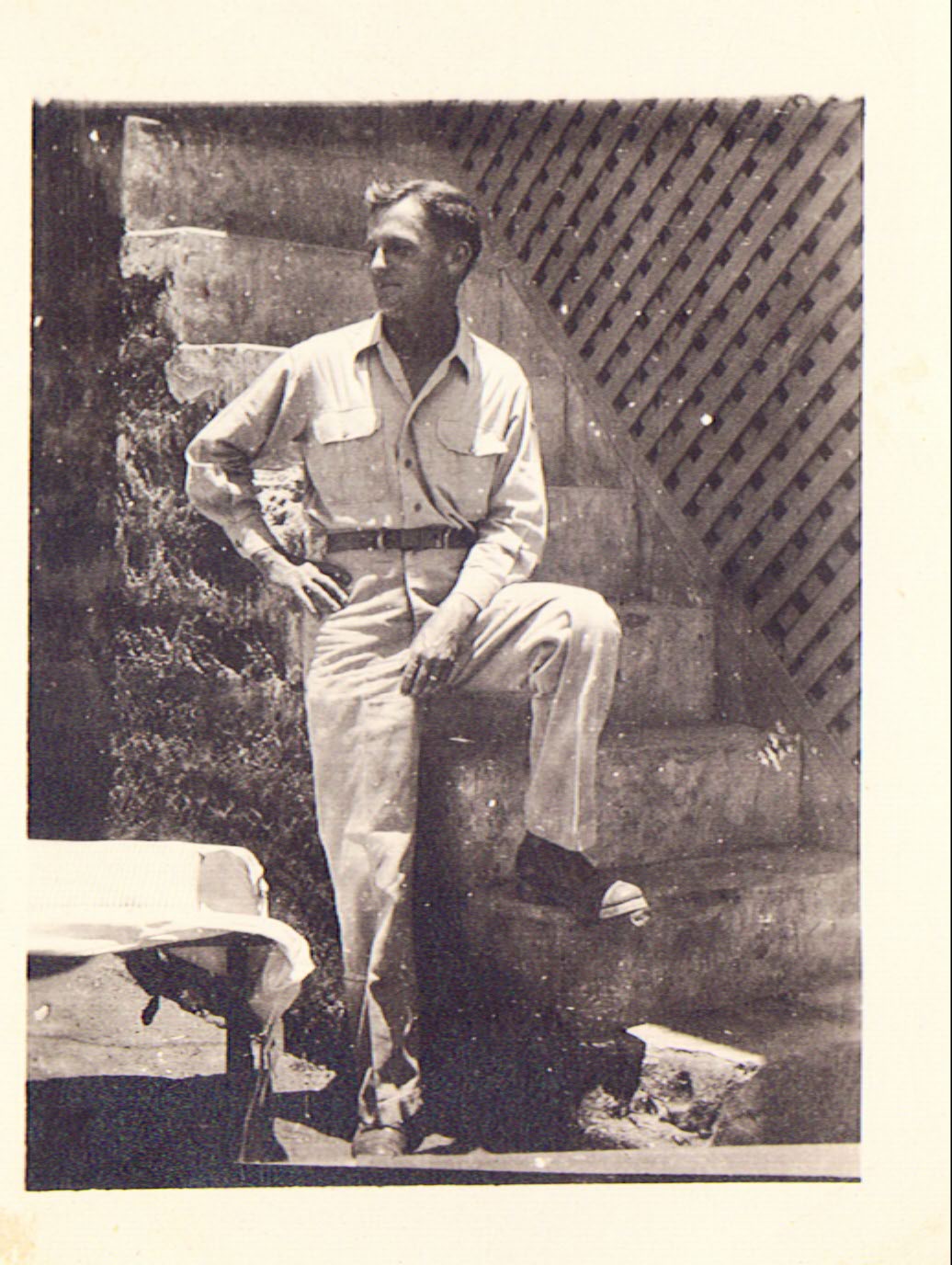
Happily, I can flash forward to the rest of their lives. The two men married women who believed in them. They fought in the Pacific during WWII and came home safely. They had children and bought homes in the suburbs. The jobs they landed were the ones they kept until retirement.

My father-in-law during WWII

Bill and my father never found much to complain about. Despite the pain of their childhoods, neither one felt sorry for himself a day in his life, and I marvel at that.  Maybe they suffered in silence. Maybe it wasn’t manly to bring up childhood wounds, or they just couldn’t find a group with which to commiserate. Maybe they were too busy.

Father’s Day was never a big deal to either of them. My dad called it “one of those made-up holidays.” Bill had trouble keeping track of holidays that didn’t occur on the same day every year. Once I made my father a Father’s Day cake, and he looked a little embarrassed. When he got old, I’d send him flowers. He’d laugh on the phone and say, “You should save your money!”

When I think of them now, I picture them in the way they spent their days — putting one foot in front of the other. Laughing when things went their way and just getting on with it when they didn’t. Without role models or support groups, somehow they became tender fathers, men their children could count on. Firm but not judgy. Loving but not mushy. Imperfect but always present.

Happy Father’s Day to the good dads everywhere. And to mine. Both of them.

Why I Don’t Throw Away My Parents’ Letters

When my parents were in their 70s, they downsized and decided on a sensible condominium. That meant leaving the house on Hamilton Avenue, in Massapequa, where I had grown up. They began getting rid of stuff, and my mother made it clear that I should make room in my car on my next visit to take some things back to Baltimore.

When I got to their house, five boxes with my name on them were stacked by the front door, my mother’s subtle way of saying, “Please get this crap out of here.”

Two contained books I didn’t read in college. Two more held clothes that might come in handy for a Halloween costume somewhere down the line, if I could ever fit into them, which would never happen. The last was a shoebox labeled, Linda’s Letters from College.

The box with the letters was unexpected. I didn’t know my mother had kept them, and knowing what they said, I wished she hadn’t. I considered just throwing the box away, unopened, knowing how embarrassed I’d be if I read them. Then I thought, “She saved them for 30 years.” So when I was back in Baltimore and alone, I opened each letter as if a hairy spider might jump out at me. They were every bit as bad as I remembered.

I can see I wrote every week of freshman year. I don’t know what got me the most — that I come from an era where people actually wrote letters, or that these innocent little envelopes contained such didactic drivel. Apparently, I had figured out everything by second semester away at a state college, and I felt the need to share.

I want to say it’s the letters from sophomore year in 1970 make me wince, but it’s worse than that. I’m ashamed of them. I was taking Sociology 101 that spring, which made me an expert on Vietnam, racial tension, and poverty. I had an epiphany in that class about my upbringing and, in those letters, hit my parents over the head with it, with lengthy paragraphs outlining their many mistakes.

They had given me a middle class childhood that I would now have to crawl out of because — really — there were few conditions worse than being middle class. Even I (who was practically a sociologist at that point) couldn’t think of anything worse. I lectured them on how they had bought into “the system.” They were materialistic. They didn’t understand oppression in America. If I had to label the tone I adopted, “How dare you!” would probably do it.

In 1950, ever the planners, my parents moved into our home a few months before I was born. Our neighborhood was just-planted maple trees, loose gravel on the road, and no sidewalks.

Most of the streets within a mile radius were named for American states and cities. But by the time they got to my street, Canada was suddenly involved with the street names Toronto, Ontario, and my street, Hamilton. I walked nine blocks to school, passing streets with names like New Hampshire, Boston, Pittsburgh, and Massachusetts, which gave me time to think about how the street-naming process should have been more organized. I wanted a street name that was American. I didn’t think it was too much to ask, considering the times and my patriotic heart. I took some solace in the fact that I didn’t live on the next street over from mine — Jerusalem — because I had no idea where Jerusalem was.

My parents wanted a house with a basement, not one built on a concrete slab, so Levittown was out. Ours was a two-bedroom Cape Cod with one bathroom. These houses also came with a garage, an unfinished basement, and an attic that, sooner or later, almost everyone would expand with a dormer for more bedrooms. Even when our parents looked at the tiny boxes these homes were, they were imagining the future.

The basement space came in handy for the rec room. I used to see ads in the Saturday Evening Post of families gathered around their ping pong tables, with trays of food behind them on a built-in bar. The lighting was always soft, and those rec rooms had carpeting. Some even had a fireplace and a piano with a dozen or so people arm in arm, belting out a tune.

Our rec room had trouble keeping up. It was at the bottom of our wooden stairs with those brown rubber pads on them so you wouldn’t trip. It had one tiny casement window, knotty-pine paneling that went halfway up the wall, and a linoleum floor in a pattern that looked like an accident of some kind. In the summer I’d make believe it was air-conditioned when we watched TV down there. In the winter you needed a blanket over you. My parents talked about mildew a lot. But at least our house didn’t sit on a slab.

My father signed up for the GI Bill and began college classes at night after his workday at Grumman was over. For twelve years, he commuted to Hofstra two evenings a week. The other three nights my mother worked the evening shift as a nurse at Brunswick Hospital, in neighboring Amityville. Those nights my father studied while taking care of me, and later, my two brothers. On the weekends they cleaned house, food shopped, and cleared the decks for the week ahead.

In the summers we took a vacation, but my father, a history buff and reader, was always partial to places like Gettysburg or Fort Ticonderoga, so even then I wasn’t having as much fun as other kids. Holidays involved the same cast of characters my whole life — aunts, uncles, cousins, and neighbors. Food, fun, and lots of noise. Imagine my angst.

That was the life I was up against when I took stock in 1970. Years and years later, I got over the embarrassing situation my parents had put me in, and began carving out — imagine this — a middle class life for my own kids. The only differences were that I worked half as hard and talked about it twice as much as Jean and Ed DeMers did.

When do you get far enough away from your childhood to really see it for what it was? Maybe when you get your first job and that alarm clock isn’t your friend, and it dawns on you that your dad did this every single morning while you were asleep in your cozy bed.

Maybe the moment you see your first baby. And that overwhelming love takes you by surprise. And only then do you understand how your parents felt the day they met you.

I think my mother knew exactly what she was doing when she handed me that box of letters. It was as if she was saying, “Someday you’ll see.”

And I kept them all. And I do.